Struck out in red: how we find out what was really played
The programme said one thing, the stage did another. An archive that wants to be an encyclopaedia has to know not only what was played – but also who says so. A look at what our certainty is built on.
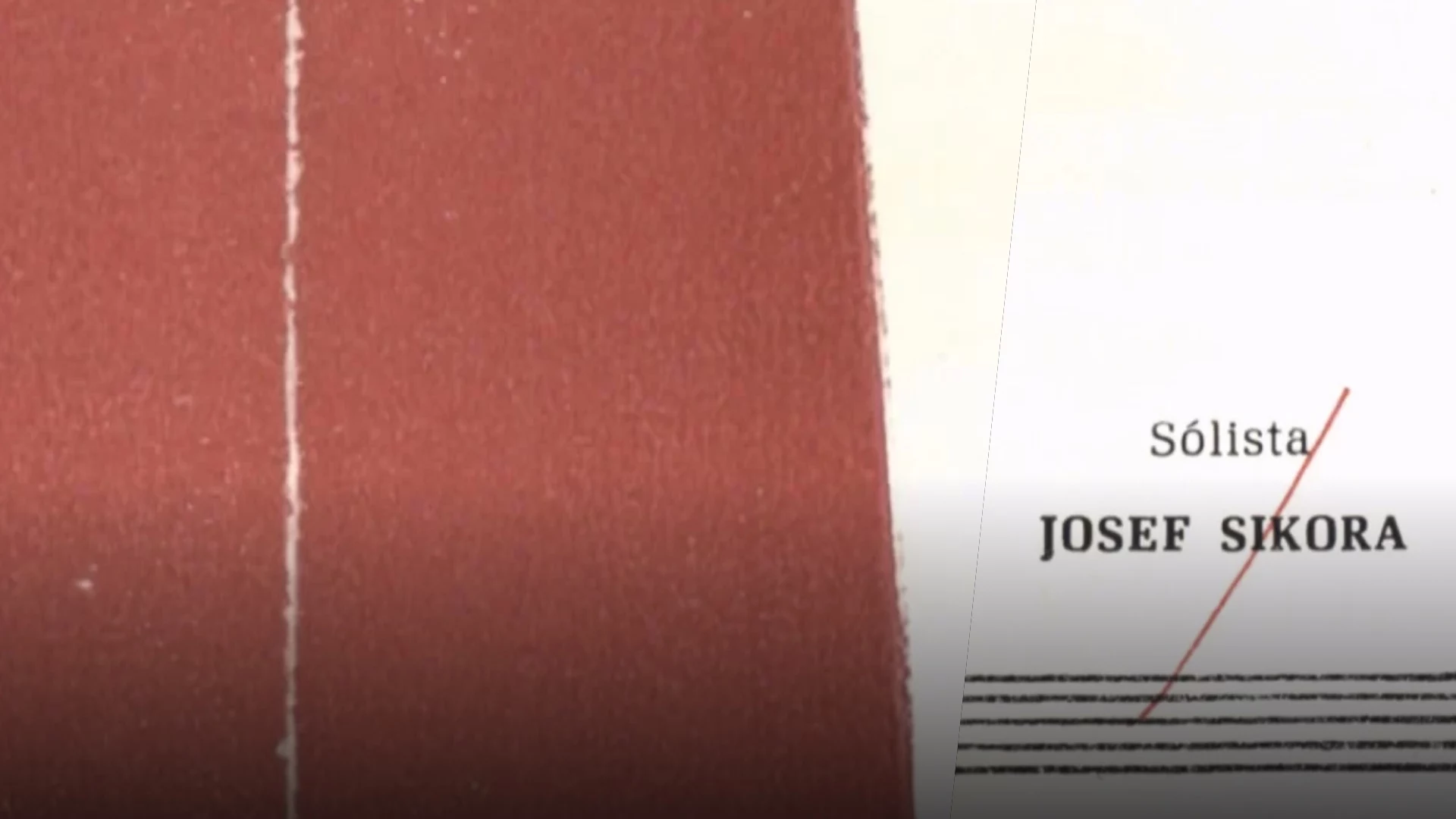
Bratislava, April 27, 1965. The Slovak Chamber Orchestra, conducted by Bohdan Warchal, is performing at the Concert Hall of the Slovak Philharmonic. The program lists: soloist Josef Sikora, cello. And Vivaldi's Concerto for Cello and String Orchestra in D major. But Sikora did not play that evening. And Vivaldi's concerto was not performed. We know this because one specific copy of the program has survived–and someone crossed out both entries in it with a red pencil. We don't know who it was. We only know that he was standing in that hall and correcting the program to reflect what was actually happening.
Musicologist Vlado Čížik confirmed this a few weeks later in the magazine Slovenská hudba: The soloist suddenly fell ill, the concert was canceled, and two other compositions were performed instead–Míč's Sinfonia in D Major “The Four Elements” and Vivaldi's Sinfonia No. 2 in G Major. At the end, the orchestra played an encore: a section from Mozart's Divertimento in D major. None of this is listed in any program. A program is a plan. Only someone who was there can say what really happened.
Why This Isn't Just a Detail
A typical archive has two options, and both are misleading: either it records what was printed–and claims that's what was performed–or it records what was performed–and omits what was announced. Our archive aims to capture both at once. For every work and every performer, we ask two independent questions: was it announced? and was it performed? Most of the time, the answer is yes to both. But it is precisely those cases where the answers diverge that are the most interesting in the festival's history.
The very first concert of the Bratislava Music Festival, on April 8, 1965: the program promised Soviet pianist Yakov Zak and Brahms's Piano Concerto No. 2. In the end, Michael Ponti took the stage and performed Rachmaninoff's Third. Even this can be recorded in the archives in a way that allows both versions to be true.
How We Determine This
To be able to say that “this was actually performed,” we need more than one source. Over the past few months, we have reviewed and verified twelve of them. These are the main ones:
List of Concert Seasons. The life's work of Anton Viskup (1953)–a chronological catalog of all concerts by the Slovak Philharmonic, 13,453 entries from 1947 to the present. Not just those at the Reduta: also tours to Vienna, Prague, and Tokyo, as well as school and chamber concerts. For each entry: date, venue, orchestra, conductor, soloists, and program.
And this is not the work of an outsider. Viskup was a double bassist with the Slovak Philharmonic**–in his own catalog, you'll find him listed among the performers of Schubert's Octet at a concert in the Reduta foyer in March 1994. He later became **program director of the Slovak Philharmonic (1996–2001 and 2003–2013). He is also a composer; his Chamber Concerto for Viola and 13 String Instruments premiered in 1989 at the Week of New Slovak Music.
For over forty years at the Slovak Philharmonic, he first played, then served as program director–and kept records along the way. This is the backbone upon which the entire archive rests: without it, we would know absolutely nothing about most of the concerts from before 2008.
Program Bulletins. Prof. Dušan Katuščák, one of the leading figures in Slovak digitization, scanned the Slovak Philharmonic's programming archive in 2013–**concert programs from 1949–1972**, page by page, double-sided, in color and shades of gray. Over 7,300 scans. It was in these that the red pencil was found.
Contemporary press. The music magazines Slovenská hudba (1957–1971), Hudobný život* (from 1969), and the Brno-based revue Opus musicum (from 1969) reviewed concerts on an ongoing basis–including the program, lineup, and sometimes even encores, which cannot be found in any bulletin. In addition, daily newspapers: for the keyword “Bratislava Music Festival” alone, we found **4,442 mentions in the digitized press, of which 2,334 were from 1960–1979.
Student Projects. In 2014, under the supervision of Dr. Marek Piaček, five students from the Department of Mediamatics and Cultural Heritage at the Faculty of Humanities, University of Žilina, processed the bulletins from 1965–2013–**Denisa Siekliková, Juraj Michalec, Peter Majerčík, Radka Sliacka**, and Maroš Spilý. Their bachelor's theses remain publicly available to this day, and we draw upon them.
And finally, our own recording. We have been recording concerts by the Slovak Philharmonic since 2008. For 87% of the works in the archive, we know exactly at which second of the recording they begin–because someone on the team actually found and marked that point. This isn't just a claim on paper. It's an observation.
A rule we've learned along the way
The book 55 Years of BHS contains a list of all festival performers up to 2019. It was compiled by the Music Center using collections from the Slovak National Archives, the SNM Music Museum, and the Theater Institute–in other words, from completely different sources and in a completely different way than those student projects. And yet it includes Jakov Zak, who did not perform**–and omits **Michael Ponti, who did perform. Exactly the same mistake. Two independent teams, two years of work, one and the same mistake. Because in the end, both teams were reading the same printed program. From this, we derived a rule that now governs all our work: independence is determined at the source level, not the editor's. The fact that two sources agree means nothing if both come from a program booklet. We consider a statement verified only when it is confirmed by a source of *a different kind*–a review written after the concert, a handwritten correction on the program, or our own record.
What's in it for you
For now, mainly a promise–this layer is still being added to the archive. But the goal is clear: for a concert where the program and reality diverged, you'll learn both. And every statement will include who is substantiating it–in a proper bibliographic citation so it can be used in a seminar paper or thesis. Because an archive isn't just a list. It is a *statement about the past*–and a statement must cite its source.
Special thanks go to Anton Viskup for compiling the list of concert seasons and to Prof. Dušan Katuščák for digitizing the program collection–without these two works, the archive prior to 2008 would have had no foundation. We would also like to thank the Slovak National Library, the Music Center, the Moravian Regional Library, and the musicologists whose reviews we now read as primary sources.
Links
- Denisa Siekliková: Dokumentácia festivalu Bratislavské hudobné slávnosti 1 (ŽU v Žiline, 2014) (opac.crzp.sk) 28 August 2026
- Hudobný život – archív ročníkov 1969–2024 (PDF) (hž.hc.sk) 28 August 2026
- Opus musicum v Digitálnej knižnici Moravskej zemskej knihovny (digitalniknihovna.cz) 28 August 2026
- Slovenská hudba 1965, č. 6 v DIKDA (Slovenská národná knižnica) – čítanie po prihlásení (dikda.snk.sk)
- Anton Viskup – profil v Hudobnom centre (hc.sk) 28 August 2026
Back to news