
Slovak State Philharmonic Košice
Dvořák's Stabat mater, Op. 58, written after the death of the composer's three children, is not only an exceptionally impressive setting of the text by Jacopone da Todi (1230–1306) depicting the suffering of the mother whose son is dying on the cross, but also a timeless utterance about human grief and hope. The piece is distinctive for unusually delicate and intellectually serious musical rendering missing any superficial effects. The quality of the score is set by its beautiful sound and purposeful juncture of human voices with soft but rich orchestral colours. Although the oratorio text depicts the dark sides of human life, the overall impression is – typically for Dvořák – mostly positive, bringing the faith in life.
Domáce orchestre: Bella, Beethoven a Dvořák [Štátna filharmónia Košice]. [in Slovak] hž.hc.sk/2017/hz_01_02_2017.pdf#page=13
Nelehká pozice po titánech. Třikrát z Bratislavských hudebních slavností. [in Slovak] operaplus.cz/nelehka-pozice-po-titanech-trikr…
Citations follow STN ISO 690 (D. Katuščák methodology) – Copy citation puts one on your clipboard.
Works from this programme also exist on record. These are different recordings — the performers and the year usually differ.
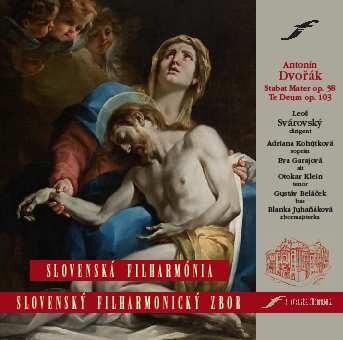 Antonín Dvořák: Stabat Mater · Te Deum
Stabat mater, Op. 58